Viser innlegg med etiketten Drama. Vis alle innlegg

fredag 7. juni 2019

Oxford Illustrated Shakespeare Dictionary


Som noen kanskje har begynt å forstå så er jeg veldig glad i Shakespeare. Jeg har lenge tenkt på å kjøpe meg ei Shakespeare-ordbok, og etter å ha levert semesterets siste eksamen bestemte jeg meg for å belønne meg selv med denne nydelige illusterte versjonen til Oxford University Press. Ordboka er skrevet av David og Ben Crystal, og illustrert av Kate Bellamy. Den er alfabetisk, som de fleste ordbøker, men har også temasider om klær, våpen, musikk, yrker og mye mer. I tillegg er ordboka full av sitater fra teaterstykkene slik at man ser hvordan (og hvor) ordene brukes. Typiske virkemidler i Shakespeares verker som retorikk, humor og fornærmelser forklares også nærmere. Jeg er strålende fornøyd, og kan anbefale denne til alle Shakespeare-nerder der ute!

Hvem hadde trodd at man kunne bli så kry av ei ordbok (hehe)?! 

– Dea 

lørdag 26. januar 2019

A Closer Look at The Merchant of Venice

This is my attempt of a close reading eassay. The text I had the pleasure of working with was The Merchant of Venice by William Shakespeare, written in 1596/ 97. It is amazing to see how much information you can get out of such a small piece of text. Exercises like this make you fall in love with Shakespeare even more, or at least I do. If anything should be unclear, please feel free to leave a comment. Enjoy!

– Dea 


A Closer Look at The Merchant in Venice

Love is a central part of William Shakespeare's comedies. I am going to have a closer look at Shakespeare's The Merchant of Venice, act 3, scene 2, line 1-185. This is a passage where we very clearly see the important role love plays. Here Bassanio determines which casket he wants to open, and after choosing the right one, he receives a ring from Portia. The scene is the moment which eventually brings the two plots of the play together, and it is a key moment for understanding the rest of the play.


In the opening of act 3, scene 2 we meet Portia, Bassanio and their trains. It is time for the casket ceremony. The two princes who have undertaken this task before Bassanio chose two different caskets and both of them were unsuccessful. The reader is therefore quite certain of which casket Bassanio needs to pick to win Portia's love. We might also have an expectation that the leaden casket is going to be his choice because it is the only casket that has not yet been opened. Another fact we might put into consideration is that the Merchant of Venice is a comedy, and that Bassanio and the other Christians are the ones we root for. A happy ending is therefore very likely, especially since there is love and marriage involved. Still, there is always a chance of failure. This choice may be the always included 'obstacle' the lover has to overcome, or it may lead to it. To begin with, we might think that Bassanio knows nothing more than the princes before him. Then again, when having a closer look, it might be that he actually does. The performance comment in The Norton Shakespeare informs us that some directors decide to present it as if Bassanio has been in Belmont for some time. This is, however, an interpretation. We do also find evidence of hints given by just looking at the text, both explicit and implicit. Portia plays with the idea of helping Bassanio decide on the right casket but arrives at the conclusion that she can not. However, the song that is sung right before Bassanio is to make his choice, tells us that love enters through the eye, and also says that 'With gazing fed: and fancy dies'. This might implicate that the caskets that are the prettiest to look at are not the right choices. If you only love with your eyes, love will die. If we transfer this meaning to Portia, Bassanio should want her and her love not because she is fair and rich, but for her inner qualities. In addition to this clue, the ending syllables, in 'bred', 'head' and 'nourishèd', at the beginning of the song, rhymes with lead. Harry Berger Jr's reflects in his article on 'The Casket Scene' on the fact that we do not know whether Portia is responsible for the hints given or not, or even if she knows about them. Neither do we know if Bassanio picks up on them. However, he claims that the important part is that 'the script encourages us to wonder about, and even to debate, the possibility'. If it is Portia who is behind the leak of information she has acted against her father's will, and also in a way managed to choose her own husband.

We understand from the very beginning that Portia wants Bassanio to choose the right casket. She has mentioned him before by name, in act 1, where Nerissa also says of him that he 'was the best deserving a fair lady'. In the opening sentence of act 3, scene 2 Portia expresses her worry that Bassanio might choose wrongly like the others. She says 'I pray you, tarry: stay a day or two/ Before you hazard, for in choosing wrong I lose your company'. Bassanio is an attractive suitor because he speaks Portia's language and has a more similar cultural background to her than the previous suitors. She has seen him before and has positive thoughts of him. Unlike the other suitors who were princes, lords and counts, Bassanio is described as 'a scholar and a soldier'. This might make him seem a bit more humble than the rest. It could also be that Portia wants a man that originally has less authority than herself. Portia stresses the fact that she can not choose her own husband, nor turn any of the suitors down. Bassanio seems to be the best candidate so far, and if he chooses wrong she could end up with someone she does not approve of. It is therefore important not just to Bassanio that he chooses right, but also to Portia.

Men from all over the world come to take part in the 'lottery' for Portia's hand. As mentioned earlier in the play, suitors who end up choosing the wrong casket are never allowed to marry at all. In other words, by taking part in this 'competition' much is at stake. Yet, maybe the fact that it is so similar to a game, where you might win or you might lose, is what makes Bassanio and the other men so interested? When we think about it, this 'lottery' has some parallels to the bond between Antonio and Shylock. There is a chance that Antonio will not be able to pay Shylock back in time, yet he agrees to the uneasy bond. Antonio is confident, and so is Bassanio in his choice of casket. The two situations are also connected in the way that Portia's money is a way to resolve Bassanio's economic issues. Marrying her is an investment. The 'lottery' is, of course, less of a gamble if Bassanio picks up on the hints.

Bassanio's motive for wanting to marry Portia is questioned quite early in the act. Portia says to him 'Then confess/ What treason there is mingled with your love', and the song includes the lines 'Tell me where is fancy bred:/ Or in the heart or in the head'. The reader also questions his motives because of the way Bassanio introduced Portia to Antonio in act 1. His main focus seems to be on her wealth, and his first sentence about her is 'In Belmont is a lady richly left'. Bassanio needs money, and marrying Portia would be an easy and quick way of gaining wealth. Furthermore, Portia compares herself to the virgin being sacrificed to a sea monster, in Greek mythology. She thereby suggests that Bassanio only wants her for the reward he is given if he 'saves her'. 

Nevertheless, Bassanio ends up choosing the leaden casket containing a picture of Portia. Portia at once places herself below her husband to be. She calls him 'her lord, her governor, her king', and says that 'Myself and what is mine to you and yours/ Is now converted'. All that she rules over and possesses is now his. As a man, he is a natural authority, though Portia is initially the more powerful and the one with the title. Portia is objectified as a 'thing' Bassanio gets along with the castle and wealth, as a reward for choosing right. This is a bit of a contrast to the symbol of the leaden casket, where Bassanio was to appreciate the inner qualities of Portia rather than just pay attention to her beauty and wealth.

In addition to the wealth, property and herself, Portia gives Bassanio one of the greatest symbols of the play, a ring. This is to symbolise her love and their unity. She says it is a ring 'Which when you part from, lose, or give away,/ Let it presage the ruin of your love'. Bassanio answers 'But when this ring/ Parts from this finger, then parts life from hence'. At this moment the ring becomes more than just an object. It is a vow. Bassanio claims that the ring will not come off his finger until he is dead. This is especially important to keep in mind when Portia and Nerissa later in the play dress up as men and ask for the ring back. When Bassanio agrees to give away his ring he does not just give away an object, but he also breaks his vow. At the same time, he becomes in a sort of debt to Portia. Portia has given him all she possibly can. She even helps save Antonio, and might have given him hints on which casket to chose. Bassanio on the other hand, after giving the ring away, has done nothing but take and receive. Bassanio's debt to Portia gives her a form of power in their marriage, similar to the power Shylock has over Antonio because of the bond. 

Apart from the action of the play, it is worth noticing the language used. In this act, as well as  in the rest of the play, the language is characterised by its frequent use of words referencing to economy and business. Bassanio says amongst other things that the caskets are 'purchased by the weight', and he uses phrases such as 'the very sum of' and 'underprizing it'. Portia's language, on the other hand, is marked by love, poetry and mythology. This affect how we see them. We think of Bassanio as a man of business, even in his marriage, while Portia seems to be a dutiful Lady. From line 1-185, with exception of the song, only Portia and Bassanio speak. This might emphasise the emotions of the two characters, and increase the tension and excitement in the room.

As we can see at lot of action crucial to the rest of the play is taking place in act 3, scene 2, from line 1-185. Bassanio has come to Belmont with the same hope as the other suitors, to marry Portia. His motives are questioned, with reason, but Portia likes him better than the other suitors. She might have had a role in indicating which casket to choose through the song, but we do not know this. Neither do we know if Bassanio chooses right because of this. He anyways become Portia's soon to be husband, and she gift him the symbolic ring, which he swears will not come off his finger until he is dead. When he later breaks his vow he also builds up his debt to Portia, something that gives her power in their marriage. The language used reflects on the personalities. Bassanio's choice of words linked to economy portrait him as a businessman both in context to his job and in personal life.


Bibliography:
Dr Elizabeth Elliott, Gender, performance and desire in The Merchant of Venice, lecture, University of Aberdeen, 09.10.18.
Dr Syrithe Pugh, The Merchant of Venice, tutorial, University of Aberdeen, 16.10.18.
Harry Berger, Marriage and Mercifixion in The Merchant of Venice: The Casket Scene Revisited, in Shakespeare Quarterly, volume 32, 1981. <https://www.jstor.org/stable/pdf/2870008.pdf> [accessed 23 October 2018] (para. 8 of 20)
William Shakespeare, The Merchant of Venice, in The Norton Shakespeare: International Student Edition ed. by Stephen Greenblatt et al. (New York and London: Norton: 2008)


lørdag 13. oktober 2018

New eyes on Shakespeare

This is an essay on William Shakespeare's The Tempest (published about 1610) and Margaret Atwood's modern version of the play, Hag-Seed (published in 2016). You should read them both. They are brilliant and might teach us a thing or two! I hope you enjoy my thoughts on the works.

– Dea 


New eyes on Shakespeare

William Shakespeare's works are often seen as the utmost of British and world literature. His plays are translated into numerous languages, and are preformed and read by professionals as well as amateurs across the globe. When one starts studying drama or literature, works by Shakespeare are rarely the starting point. His works are considered being advanced and there is, when analysing his plays, usually a large amount of interpretation and literary and dramatic terms and tools involved. Even professionals struggle to understand and agree on all the aspects in the various plays. However, after reading Margaret Atwood's novel Hag-Seed1, my impression is that we do not really need as much as we often think to enjoy and understand Shakespeare. My thesis statement in this essay will therefore be that: 'The Tempestby William Shakespeare is relevant and reliable to most people'. Atwood's book helps us read Shakespeare's The Tempest in a different way. I will be using her book as my main argument. 

Atwood has very neatly recreated The Tempest in a modern setting. The almost same story is presented twice. This helps us sort out what is important to pay attention to, not only in the novel, but also in the play. Felix is a modern Prospero. He loses his work and passion as a director, and decides to seek revenge on those who betrayed him. There are two Mirandas. Both Anne-Marie who plays her and Felix's daughter Miranda, who is 'present' even though she died many years ago. Felix's daughter also gives strong associations with the air spirit, Ariel, of whom there are two. 8Handz plays Ariel in the production. Tony is a clear parallel to Antonio. He stole Felix's 'kingdom' and encourages Serbert to act the same way. Lonnie is a parallel to Gonzalo, Sal to Alonso, Serbert to Sebastian, and Freddie to Ferdinand. Caliban is played by Leggs. Quite a few of the inmates may feel like Caliban, rejected and on their own, an outcast. In a way the entire prison may be filled with Calibans. As in the play, the theme is revenge, used as a driving force, eventually turning into mercy and freedom. 
Atwood feeds us information through systematic schemes and analyses. By presenting the same personalities and actions several times one can not miss the story and plot of Shakespeare's The Tempest.Hag-Seed presents both the 1610 version of the play and a modernised version, making the reader notice parallels between the two. The likenesses in how the characters act and feel, though there are hundreds of years between them, are striking. Shakespeare is for everyone precisely because of this. His plays presents the most fundamental human nature. Everyone will eventually face these feelings, in them selves or in others. We not only recognise these sides of being human, but also see how these actions are present in our contemporary modern society. Simultaneously it shows us how Shakespeare's works continue to be relevant and provoke our feelings. Some will argue that the 400 year old play is, despite its age and distinct language, can not be outdated. 

Most plays include three essential elements, namely setting, time and place. These units are traditionally quite concentrated, or limited3, and this is also the case in The Tempest. It is, however, important to keep in mind that The Tempest is a play made to be preformed on stage, while Hag-Seedis a novel that is only to be read. However, Hag-Seed, which is not a play, also to some extent follows this way of presenting a story. As mentioned above, there are in a way two of each unit in Atwood's novel. The settings, what the main conflict consists of and how the main characters are connected to it, are quite similar in the two stories. Someone steals the main character's 'kingdom' and 'title'. The story of both the play and the novel stretches over, somewhat, the same amount of time. In the play it seems that a minute 'on stage' is a minute in real time4. The backstory is summed up by Prospero in act 1, scene 2. In Hag-Seed the backstory is more thoroughly presented. The main part, in present time, still takes place when the main character presents his play and finishes his revenge, however, the planning of the revenge is also included. In The Tempest Prospero and Miranda spend twelve years on the island. This is the same amount of time Felix uses to plan and carry out his revenge in Hag-Seed. The place, where we are, is set to the island in The Tempest, and mostly to the Fletcher Correctional in Hag-Seed. Though in different ways, they are both prisons. The three units gives us the very framework of the play, and in this case, also the novel. 

In Atwood's Hag-Seed the story and plot of The Tempest is broken into small pieces. Felix helps the inmates, and the reader, put these pieces back together, one by one. The reader may almost feel like he is part of a children's theatre where he is 'fed' the basic parts of the play. The play is presented in a way that is enjoyable and understandable to all kinds of people. To many, a play dating back to the 1600s may seem a bit heavy, but Atwood's book argues that it does not necessarily have to be. This is much due to the way Shakespeare presents primal human emotions and actions, as mentioned above. Atwood makes sure the reader is a part of the characters feelings in the parallel stories. 
To understand the play we need to have a somewhat understanding of the characters in it. The question is, how are we to understand the characters, and how much of them do we need to understand? In Hag-Seed Ariel is initially an issue for the inmates, because no one wants to play 'a fairy'. Felix solves this by listing up Ariels qualities. What we know about Ariel is that 'he can be invisible', 'he can fly', 'he has superpowers', 'he's musical' and 'he's not human'5. Felix presents this information as something we are free to interpret the way we want. We may do the same with all of the characters. What exactly do we know about them? Is Prospero a madman, a caring father or maybe both? Is Miranda naive and defenceless or smart and independent? Ariel is something different, and hard to define. The inmates understand him to be an alien. The description in the play presents him as an airy spirit. Miranda in Hag-Seed seems to be something in between a ghost and a memory. Hag-Seed lets, the inmates, and the reader, read the characters with what we think is our personal understanding. Yet really, as the director, Prospero, Felix, or even Atwood, pushes the readers and inmates in their preferable direction. 

The characters are to a great extent characterised by their actions. To understand these actions we need to know some of the characters backstory, and their relationship towards the others. In Hag-Seedre-shaping of scenes helps the inmates understand the play, and even more the characters in it. For instance act 1, scene 2, is transformed from Prospero's long explanation of his and Miranda's situation and past, to a flashback-rap by his brother Antonio. It is a short and concise way of describing why Prospero and Miranda are on the island, and why Prospero seeks vengeance. Caliban is also introduced by a rap. This information is presented on the inmate's terms, in a way that is reliable and a bit closer to their world. Yet the original feelings and actions remain the same. The play is given their own distinctive character, which again may lead to a deeper understanding and relevance.

As in any play some aspects of The Tempest are more important to understand than others. Felix gives three assignments in Hag-Seed. Thesemake sure the inmates, and the reader, understand the most important parts of the play. The assignment considering curse words helps them get an overview of the play. This assignment also shows us that Shakespeare was not as 'posh' as he is often made out to be today. Atwood's way of presenting The Tempest could be seen as a way of giving Shakespeare back to the common people4. The second assignment, where the inmates were to find who is imprisoned by who and where, makes it clearer what situation the different characters are in, and their feelings towards the others. This is a key to understand the play and is presented in a scheme in Hag-Seed. The different groups the characters are divided into also helps the the reader of the play understand these feelings even deeper. The characters in The Tempest are not put in random groups, but are carefully placed there by Ariel on command from Prospero. Their feelings towards each other are, both through speech and action, in a way emphasised inside these groups. The last assignment in Hag-Seed, where the inmates are to imagine what happens to the characters after the play, may also teachus something. To imagine their future we must understand their present selves. The assignments in Hag-Seedare a very systematic way of gaining this significant knowledge about the play.

However, The Tempest includes some tricky elements which are hard to explain and understand. One of them is magic. It is impossible to attack the play with logic, reason and personal experiences alone. Imagination is a central part of our minimum understanding. We need imagination to understand Ariel, Prospero and the tempest itself. Another thing is how much of The Tempest that is happening within Prospero's own mind6Hag-Seedmay help us in particular with this aspect. Having the long gone Miranda as Felix's moral compass, a constant presence and a feedback gives us not only a deeper understanding of Felix's own thoughts, but might also add an extra layer to Prospero. The Tempest is famous for being a play within a play. Hag-Seed explains this aspect by presenting The Tempest as a play within a play within a novel. Both The Tempest and Hag-Seed have symbolic and deeper meaning that may make the stories fell like a lot to take on. Nevertheless, reading Hag-Seedone is almost guided through the famous comedy, and will have solid foundation for further reading.

Atwood's Hag-Seed makes the reader rethink all he knows about Shakespeare's The Tempest. The play may be read and interpreted in many different ways. Some choose to read Prospero as the hero, others Caliban. Some choose a colonist or historical reading, while others see it as a fictional play about family, revenge and forgiveness, or romance. The recognisable feelings are there all the same.
Shakespeare's plays are played of all from amateur children's theatres to the professional Royal Shakespeare Company. These two groups, and all in between, will have a different understanding of the play. The play might be richer if we understand the symbol of chess, how The Tempest is a play within a play, or how it may be understood in a colonial setting. Still, it can definitely be discussed whether this information is necessary to enjoy and understand the story and plot. The inmates' interpretation of Ariel or solution to act 1, scene 2, shows us that our personal interpretation may be as justified as any critic's. However, it is to some extent controlled or restricted. To conclude, one might argue that The Tempest is relevant and reliable to most people because of the focus on basic human emotions.Atwood's novelshows us, in a very straightforward way, that the feelings and the actions of the characters in The Tempest are as common now as they were in 1610. Shakespeare does not have a date of expiry. There are some universal truths about what it is to be human that have not changed in the last 400 years, and probably will not change in the next 400. To recognise these feelings or actions is a helpful tool, and is often what plays aim to do. Hag-Seedhelps us see, or maybe just reminds us, that Shakespeare does not only belong to the high culture, Shakespeare belongs to all!

Bibliography:
Atwood, Margaret. Hag-Seed. (London). Vintage. 2017.
Pellicer, Juan [The Tempest and Hag-Seed, second lecture] University of Oslo. 06.03.18
Shakespeare, William. The Tempest. (Great Britain) Penguin. 2015.
Steinman, Kevin. [The Tempest and Hag-Seed] University of Oslo. 20.01.18
Vestøl, Magne. Dramatisk diktning.Accessed 13.02.18.

torsdag 31. mai 2018

Macbeth


Forfatter: Jo Nesbø
Utgitt: 2018
Sjanger: Krim/ thriller

Det er klart man blir litt ekstra kritisk når noen tar på seg å modernisere et verk av en av de største, hvis ikke den største, forfatteren gjennom tidene, fantastiske William Shakespeare. Men etter å ha lest Hag-Seed av Margaret Atwood, en modernisering av Shakespeares The Tempest (som var fantastisk bra!), måtte jeg jo gi Nesbø en sjanse også. Selv on Nesbø har tatt en noe "lettere" vei enn Atwood har han klart å skape en moderne krim i sitt eget univers med særtrekk og kjennetegn fra Shakespeares verden, og det er ikke bare bare.

Nesbø har modernisert Macbeth, og valgt å bruke navnene fra det originale stykket. I starten likte jeg det ikke, men etter hvert som historien blir trekt mer inn i Nesbø sitt landskap tenker man ikke like mye over det. Det gjør det også relativt lett å følge orginalhistorien og se parallellene. Det som imponerte meg mest var nok hvordan Nesbø har løst de ulike rollebesetningene, og hvordan de moderniserte karakterene utfyller rollene sine så godt. En liten genistrek må man nesten si å for eksempel å gjøre heksene om til transseksuelle prostituere som jobber for Hekate, narko-kongen som ingen ser. 

Selv om man på forhånd (dersom man har lest eller sett Macbeth av Shakespeare) vet hvordan historien ender og hvem som dør på veien, var i alle fall jeg fortsatt spent på hva som kom til å skje på neste side og i neste kapittel, mye fordi vi kanskje får komme enda litt mer inn i tankene og følelsene til karakterene i Nesbø sin versjon (noe som gjerne er tilfellet i romaner kontra drama). Det eneste jeg egentlig har å utsette på boka er at den til tider er litt unødvendig grov (etter min smak i alle fall). Jeg har også hørt at noen synes den var litt stillestående til tider (kanskje erfarne krimlesere?), men det er jeg uenig i. Spenningen og tankene som bygges opp før et drap er jo mye mer spennende enn drapet i seg selv!

Boka kan absolutt anbefales, og det til og med av en som ikke er glad i krim (men så er jeg jo veldig glad i Shakespeare da). 

I tillegg til Atwood og Nesbø er også Howard Jacobson, Anne Tyler og Jeanette Winterson del av prosjektet med å modernisere Shakespeare, så her er det mer å lese og å glede seg til.

– Dea 


lørdag 28. april 2018

Hag-Seed


Forfatter: Margaret Atwood
Utgitt: 2016
Sjanger: Roman

Hag-Seed er en modernisert versjon av William Shakespeares The Tempest, og et strålende eksempel på at Shakespeare ikke har "gått ut på dato". Vi møter ressigøren Felix, en moderne Prospero, som etter å ha mistet jobben sin bestemmer seg for å hevne seg på dem som tok den fra han. Vi får presentert handlingen i The Tempest to ganger, både gjennom den moderniserte versjonen der Felix er hovedpersonen, og gjennom oppsetningen av Shakespeares stykke fra 1610. Det meste av handlingen foregår inne i et fengsel, noe som er en genial moderne løsning på en øde øy. Atwood viser tydelig hvorden menneskers grunnlegende følelser ikke har endret seg på det 400 årene som har gått siden Shakespeare skrev The Tempest. Disse følelsene, vil jeg påstå, er en av de største grunnene til at verkene hans fortsatt føles så relevante. Atwoods roman plukker fra hverandre den kjente komedien, og setter den sammen igjen. Kanskje får dette oss til å se på både teaterstykket og samfunnet vi lever i med litt nye øyne.

Romanen har navnet sitt etter et av de mange stygge kallenavnene til Caliban. På norsk heter den Hekseyngel. Den er ei av åtte moderniserte versjoner av Shakespeares verk, skrevet (noen er under arbeid) som del av Vintage sitt prosjekt for å feire Shakespeare og de 400 årene som har gått.

Boka er en fryd for oss som er glade i Shakespeare, og en ny og spennende vinkel for dem som er litt skeptiske. Kan absolutt anbefales!

– Dea 

onsdag 17. mai 2017

Fröken Julie - ett naturalistiskt sorgspel


Forfatter: August Strindberg
Sjanger: Drama
Utgitt: 1888
Første gang oppsatt: 1889 (1906 i Sverige)

Dette er et stykke som er moderne for sin tid. Det ble sensurert på omtrent 870 steder i manus før det kom ut, og fikk også svært mye kritikk av den konservative svenske pressen. Spesielt forestillingen om at kvinnen er lik mannen var urimelig. Tragedien har kun en akt og en handling. Strindberg har brukt dialog på en måte som ligger nærmere den ubearbeidede virkeligheten. I stykket møter vi grevens datter, fröken Julie, tjeneren Jean og han forlovede, tjenestejenta Kristin.

Handlingen finner sted på et herregårdskjøkken fra Sankthansaften til påfølgene morgen. Fröken Julie har blitt igjen sammen med tjenestefolket i stedet for å bli med sin far, greven. Hun danser med dem, noe Jean mener sender feil signaler. Han forteller sin forlovede, tjenestejenta Kristin, at han har danset med fröken Julie og Kristin svarer at selv om frøkenen ikke er helt god så er hun fortsatt deres overordnede. Når Kristin sovner utvikler forholdet mellom fröken Julie og Jean seg til et seksuelt kjærlighetsforhold. De låser seg inne på Jeans værelse for å unngå tjenestefolket. Dette gjør at fröken Julie faller fra overklassen til underklassen, og derfor ikke har noen plass i samfunnet lenger. Fröken Julie og Jean planlegger å rømme fra gården, og fröken Julie går ovenpå for å pakke. Jean er så kry over det som har hendt at han forteller det til Kristin som nå er våken. Kristin gjør det klart at hun kommer til å gjøre alt hun kan for å stoppe deres flukt. Deretter kommer greven hjem, og Jean mener at den beste løsningen på situasjonen er at fröken Julie dør. Den morgenen går fröken Julie ut døren med Jeans barberkniv i hånden. Slik slutter stykket.

Karakterene i tragedien er sammensatte, og som stykket i seg selv, svært moderne for sin tid. Fröken Julie ble oppdratt av sin mor til å tenke som en mann. Hun har også bygget opp et hat mot menn. Etter morens død ble hun oppdratt av sin far til kvinne og datter. Dette har gjort henne til en forvirret person, som ikke vet hva hun vil eller hvilken rolle hun har. Hun har nylig brutt opp forlovelsen sin, og er fortsatt ugift i en alder av 25 år. Fröken Julie forstår ikke selv konsekvensene av det hun gjør før det er for sent.

Jean er en stolt, vulgær og belest mann. Han hører til underklassen, og har et sterkt ønske om å klatre i klassesamfunnet. Jean manipulerer fröken Julie, og er også den som til slutt ber henne ta sitt eget liv. Han vil aldri kunne klatre via fröken julie ettersom han er en mann fra underklassen og hun er en kvinne fra overklassen. Likevel bytter de roller når fröken Julie faller. Jean blir "hersker" og fröken Julie blir "tjener".

Kristin blir en bifigur i stykket. Hun er stabil og den eneste i stykket som har godtatt den rollen har i samfunnet. Dette fremhever de to andre karakterenes ustabilitet og utilfredshet. Greven blir bare nevnt, men det er tydelig at han har stor innvirkning og makt over fröken Julie og Jean. Han representeres gjennom et par støvler og et par hansker.

Stykket hører som tittelen tilsier til naturalismen. Det er svært bundet til tid (spilletid = virkelig tid) og sted (sceneanvisninger), og preges av eksakthet uten restriksjoner og tabuer. Dette legger man spesielt merke til på språket som brukes. Strindberg mente at alt i prinsippet skulle redegjøres for i den litterære teksten eller på scenen. Karakterene er et resultat av arv, miljø og omstendigheter.

For å skyte inn en liten kommentar på slutten så vil jeg bare si at jeg synes dette var et vanskelig stykke å forstå. Litt fordi det er veldig preget av sin tid, og litt fordi det er på svensk 1800-tallsspråk. Når man har lagt litt arbeid i det blir det mye morsommere å lese med en gang. Hvis du ikke har lest stykket er det ingen dum ide å ta seg tid til det.

– Dea 


mandag 10. april 2017

Peer Gynt


Forfatter: Henrik Ibsen
Sjanger: Drama
Utgitt: 1867
Oppsatt første gang: 1876

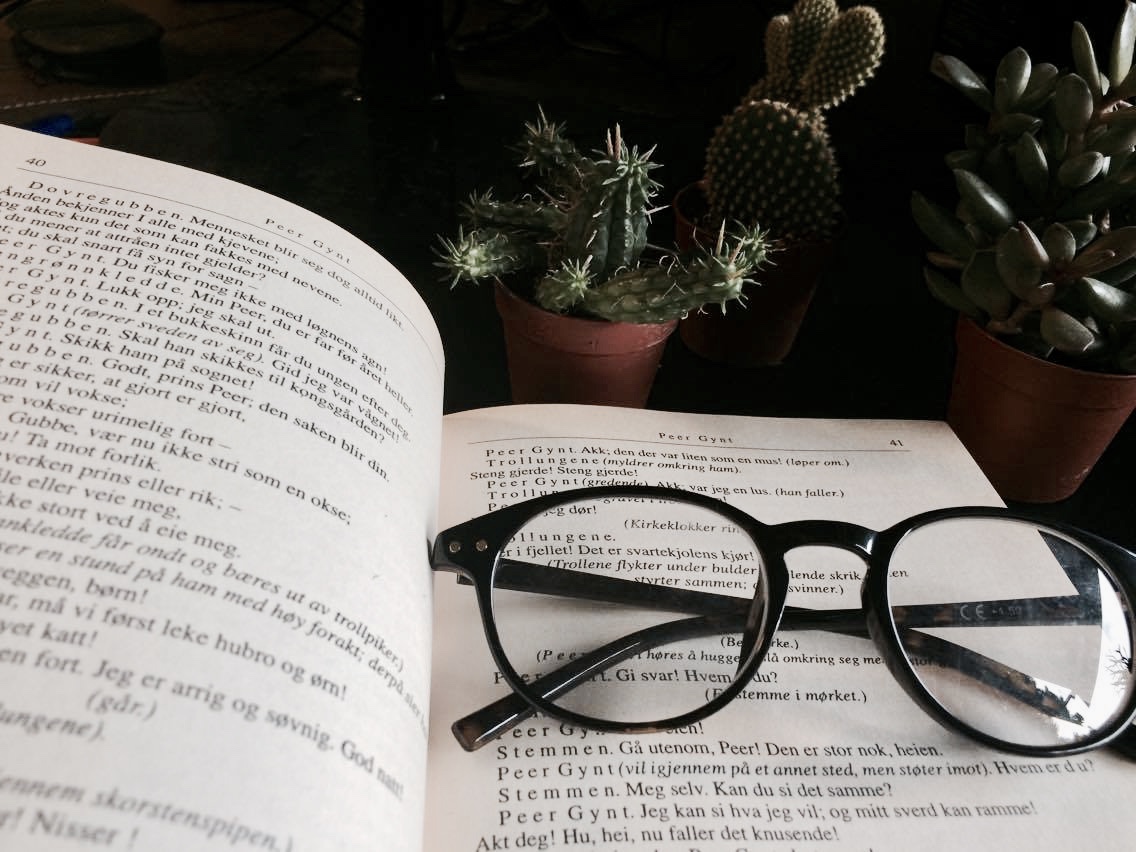
Dette er helt klart et av mine favoritt-stykker! Alle har hørt om Peer Gynt, men det er kanskje ikke alle som har tatt seg tid til å lese dramaet. Det bør du gjøre! 

Peer Gynt handler om Peer Gynt som ljuger og sniker seg unna alle vanskelige situasjoner. Han er selvopptatt og feig, og ikke spesielt godt likt i bygdesamfunnet. Etter at han har kidnappet en brud, gjort datteren til Dovregubben gravid, funnet en som elsker han og mistet sin mor, drar ut i verden for å bli keiser. Vi følger Peer fra han er omkring 20 år til han er en gammel mann og kommer tilbake til Norge. Han møter Knappestøperen som vil smelte han om fordi Peer verken er verdig himmelen eller helvete. Dette unngår han så vidt ved å bevise at han har vært seg selv. Hans elskede Solveig har nemlig ventet på han alle disse årene, og hatt Peer i sitt hjerte.

Stykket er psykologisk komplekst og litt vanskelig å forstå. Det er et identitetsdrama, et selvoppgjør,  som stiller spørsmål ved hva det vil si å være seg selv. Karakterene kan tolkes i mange ulike retninger, men dette er også noe av det som gjør stykket så interessant. Mange av karakterene kan for eksempel minne om faktiske personer fra Ibsens samtid. Dramaet spiller på den norske selvgodheten, og er inspirert av sagaene om Per Gynt fra Gudbrandsdalen. Et annet aspekt ved dramaet som gjør at det skiller seg ut er at det er skrevet på vers, det er et dramatisk dikt. Det er bevisst bruk av trykklette og trykktunge stavelser, linjedeling og rim. Verket plasseres gjerne under den poetiske realismen fordi det utfordrer (eller i alle fall ønsker å utfordre) nasjonalromantisk tankegang, men er romantisk skrevet. Flere av oppsetningene på teater har likevel oversett satiren og fremstilt stykket som nasjonalromantisk. 

– Dea